Showing posts with label jewelry. Show all posts

Monday, January 26, 2015

The 2015 Bead Peeps Swap N' Hop!

http://fromthebeadboard.blogspot.com/2015/01/bead-peeps-swap-n-hop-is-coming.html


Welcome to Part 1 of a series of blogs made specifically for the 2015 Bead Peeps Swap N' Hop!  We joined this fabulous event very recently, and would like to start off showing y'all what we do in Dry Gulch Beads and Jewelry.  In this blog, we'll be talking a little bit about us and how we got started, and then we'll showcase some of the jewelry we create.  Sit back and enjoy the ride!

1. Why or how did you get started making jewelry?

Dry Gulch Beads and Jewelry is a family-owned business having three generations of women designing and creating beautiful jewelry to be worn casually, professionally and formally. We are Deborah (Grandma), Jennifer (Mama), Catherine and Gianna (Cat and Bean - Granddaughters). Not only have we had a “brick & mortar” store located in Joplin, MO. for the past 10 years, but we also have a retail/wholesale website with clients and customers from around the world. We carry a large selection of crystals, beads, findings, chain and tools etc. and our finished jewelry is also sold in several boutiques. We also create torch-fired lampwork beads, hand-cut and stamped metal, painted and enameled components and many other custom pieces. We have a love of “vintage” and often incorporate that into much of our jewelry. We are a “work in progress”.


(left to top to right to bottom) Gianna, Jennifer, Dave, Deborah, Catherine


2. What style(s) of jewelry do you like to make?

Because there are four of us, our jewelry has a really big range of styles!  We create earrings, necklaces and bracelets, and occasional odds and ends like bookmarks and key-chains.  We love vintage and antique styles and often reuse vintage jewelry components in our works.  We also love mixed media, and incorporate leather, wire, metalsmithing, paper, paint/enamel and fibers in our work.  Deborah's works tend to be bohemian in style, Jennifer loves to break down and re-imagine vintage jewelry, Gianna creates intricate Victorian-inspired works and I (Cat) enjoy metalsmithing and playing with leather. 

http://www.drygulch.com/3-tieredpinkcrystalflowercabochonssilverplatedchainnecklace-2-1-1-1-1-1-1-1-1-1-2-1-2-1-1-1-1-2-1-2--4.aspx
Mixed media Faith Bird Trio necklace by Deborah

3. What materials do you prefer to use (and which ones do you avoid)?

We don't really shy away from odd materials!  The older the materials the better, and hand-fabricating from start to finish like in metal-smithing is a challenge we love tackling.

Seed bead earrings by Gianna


4. What techniques do you prefer (and are there any you don't like)?

We love all techniques!  We enjoy metalsmithing, leather working, lampworking, crocheting, and seed beading.  One of the things we really haven't tried is polymer clay, but we will remedy that soon!

 Mixed media necklace by Jennifer
Mixed media necklace by Jennifer

5. What colors do you use most, and which do you run screaming from?


Also the same answer as #4, we don't shy away from any color in particular.  While we tend towards the vintage styles, which includes colors like pastels and neutrals, we also love to break out of the box and create with colorful and bright palettes too!

Leather message bracelets by Catherine and Deborah


Friday, January 23, 2015

The Dry Gulch Stone Journals: Labradorite

On today’s blog we continue our blue-stone streak and introduce the fantastic Labradorite! This handsome stone is well-known for its fantastic shimmer. Read on to learn more about this semi-precious beauty!

 
http://www.madagascarminerals.com/pd-peacock-blue-labradorite-rough-50-500gpc-5lb.cfm
Labradorite rough from Madagascar. Ready for cutting and polishing.


Labradorite is a member of the Feldspar family of rocks, and is a mix of calcium, sodium, aluminum, silicon and others. It is found in magma-born rocks like basalt. The stone is generally a semi-translucent base of grayish rock. Its luster, called labradorescence, occurs because the metallic elements did not fuse while cooling; instead they coexist closely together and produce a light diffraction effect colored with beautiful shades of light blues, greens and yellows. Labradorite is almost exclusively found in the northeastern province of subarctic Labrador, Canada. Some other varieties have been found in Madagascar, and Spectrolite is a very dark Labradorite with more color play from Finland. Rarer purple Labradorite also exists, with a shine that plays up orange, lavender and blue hues. Labradorite has been called Black Moonstone, and while it and Moonstone are of the Feldspar family, Moonstone has a white base and contains potassium instead of calcium. 


https://energymuse.wordpress.com/2012/07/05/gemstone-of-the-day-labradorite/
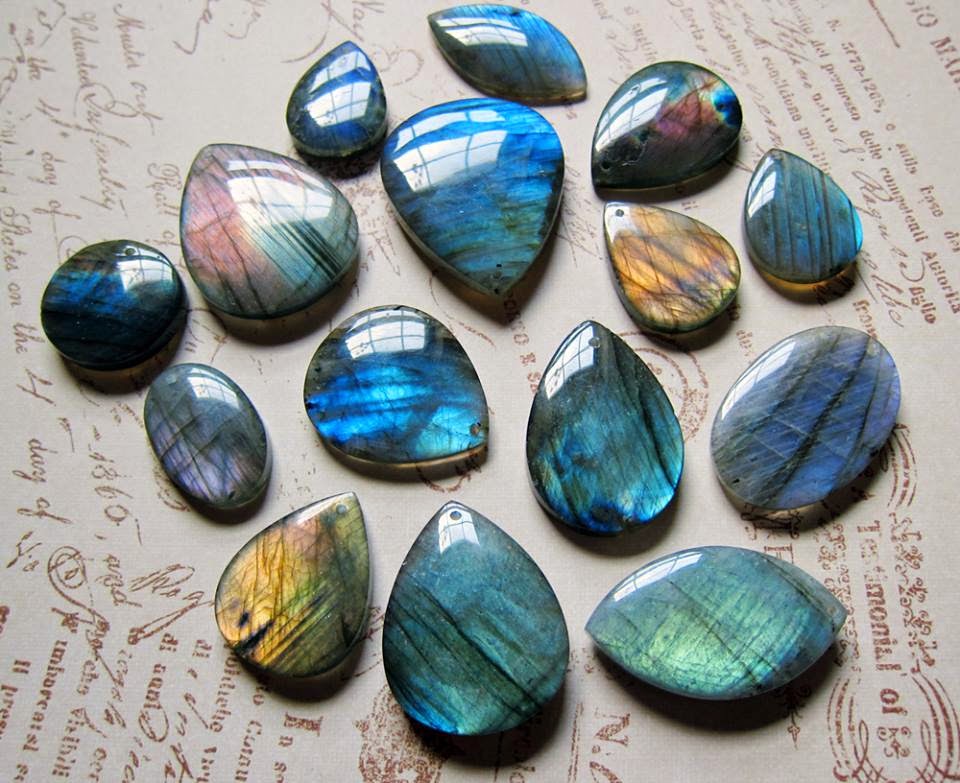
Labradorite stones, cut and polished.

Labradorite has a hardness of 6 to 6.5 on the Mohs scale. It can be sliced, carved and polished. It is a newer stone in jewelry making history, it was discovered and introduced to Europe in the late 1700s. The native people of northern Canada, called the Inuit, used the “firestone” as medicine or offerings. They tell several legends of the “firestone” origin, but one striking story is that of an Inuit warrior who roamed the Labrador coasts. He found the Northern Lights trapped in the rocks, and with a mighty strike of his spear, he freed many of the Lights. However, some remained enclosed in the stone and became Labradorite. 


https://sihayadesigns.wordpress.com/2013/02/26/whats-going-on-at-sihaya-designs/
Labradorite cabs, cut and polished, ready for use. Notice the vast range
of colors, like rust, lavender, sky blue, moss green and yellow.
Labradorite is revered for its flashing brilliance, and has many metaphysical properties. It is said to aid in matters of the mind, and can help with clairvoyance and telepathy. The flashing colors bring spontaneity and happiness to the wearer. Because Labradorite tends to be blue, it is usually associated with the throat chakra, a Hindu concept that brings clarity and energy to the individual. It is also believed, when worn as a ring, to be beneficial to persons who use their hands because it brings energy and positivity to the hand and whatever the hand touches.


This stone has been used for centuries in jewelry, and is still in use today. It is well loved for its color play, but care must be taken when cutting and polishing it because of its many layers (the source of its shine). Many artisans use it in earring and necklace designs to help preserve it during wear, but larger, unfaceted forms can be used in bracelets and rings. Labradorite continues to be a staple for jewelry artisans everywhere!


https://www.etsy.com/listing/61633955/truly-elvish-labradorite-pendant


Above and below is a collection of contemporary jewelry made with common and rare Labradorite stones.  Above left is a sterling silver and Labradorite pendant named Truly Elvish, made by ElnaraNiall.  Below left are mixed-metal earrings with Labradorite created by Sky & Beyond.  On right is a sterling and Labradorite necklace designed by Mirinda Kossoff.

Below left shows a purple Labradorite ring made with sterling silver by Ashley Spatula.  On right is a Spectrolite, sterling silver, tanzanite and pink sapphire in a hand-fabricated pendant by Different Seasons Jewelry. Notice the greater and more intense range of colors and nearly black base.


Also see our website at www.drygulch.com to see our collection of Labradorite bead strands!

http://www.drygulch.com/largebrioledroplabradoritesemi-preciousbeads.aspx

Thursday, January 22, 2015

The Dry Gulch Stone Journals: Lapis

Lapis rough ready for cutting and polishing.
Today on our semi-precious lore blog we’re discovering Lapis lazuli. This beautiful blue stone is rich in jewelry making history. Read on to learn all about this fabulous stone!

Lapis lazuli is a blue semi-precious stone known since ancient times. Its color ranges from pale blue to a royal, rich blue, and it often has white or black marbling. It also has metallic gold flecks. It was used by the Egyptians in jewelry, medicine and beauty as early as the 3,000s B.C., but has been mined as early as the 6,000s B.C. It’s been used throughout history as an artistic element, whether that be an entire room of Lapis walls and furniture during Russian empress Catherine the Great’s reign, or ground down to pigment and mixed into paint used by artists during the European Renaissance and Baroque eras. With a hardness of 5.5 on the Mohs scale, Lapis can be easily carved and always polishes to a lustrous shine. 

Virgin Mary (1640-1650) by Giovanni Battista Salvi da Sassoferrato. The blue paint in this work is Ultramarine, made by grinding Lapis lazuli into pigment and mixing it with binding agents.


Necklace with vulture pendant, from the tomb of Tutankhamun (c.1370-52 BC) New Kingdom (gold encrusted with lapis lazuli and carnelian). Amulet found in Tutankhamun's mummy suspended from his neck; representation of the vulture-goddess of Upper Egypt, Nekhbet; hieroglyphic sign for 'eternity' (shen) in the talons; discovered in 1922 in the Valley of the Kings by Howard Carter.
Lapis rough in a white marble matrix from Afghanistan.
 
The name Lapis is Latin for stone and lazuli is an old Persian name for the blue rock. Lapis is made of mostly Lazurite, with flecks of color coming from iron Pyrite (gold color) and calcium Calcite (white color). Lazurite is made of sulfur and chloride, and almost exclusively appears in marble deposits in mountainous regions. There are small deposits of Lapis in the U.S., Russia and Chile, but most Lapis in the ancient and modern world comes from the Badakhshan province of northeastern Afghanistan.

With Lapis having such a rich and ancient history, it is bursting with metaphysical properties and legends. In Hindu and Buddhist religion it is the stone of the throat chakra, and aids in diseases of the throat and head. It brings energy to the body and opens up channels for that energy to flow. It also known for its calming effect, and lends clarity and patience to the wearer. In ancient Chinese traditions it is associated with water and brings serenity and wisdom. The word Lazuli also stems from the Arabic Lazaward, meaning heaven or sky. Lapis’ rich blue color with golden flecks is synonymous with a night sky.


Lapis can be graded according to richness of the blue color, for example “milky” or pale Lapis would be C Grade, and rich blue with Pyrite flecks would be A Grade. Depending on the artist’s intent and design, any of the grades would suffice. Wherever artists pick up Lapis to use in their designs, they can be sure that they have a true gem stuffed full of ancient history and legends in their hands.


Lapis lazuli cabachons polished and ready for use. Left is Grade C, middle is Grade B and right is Grade C.

Modern Lapis lazuli and vermeil gold ring by Delezhen.


Visit www.drygulch.com and see our collection of Lapis beads that are perfect for your designs!

Lapis lazuli bead strands from Dry Gulch

Tuesday, January 20, 2015

The Dry Gulch Stone Journals: Garnet

Welcome!  This month, Dry Gulch will be blogging the history, science, properties and lore of all different semi-precious and precious stones. We'll talk about all the different birthstones, and about lesser-known semi-precious stones too. Today in our first post of the Dry Gulch Stone Journals, we're discovering Garnet.  Read on and discover more about this versatile and lovely rock!

Garnet rough ready to be cut and polished.

Garnet is the traditional stone for the month of January, and is known for its deep red color and glowing brilliance. The name Garnet comes from the Latin word "grānātum" for pomegranate, because the stone in the rough form tends to form in small grainy clusters that look like the seeds in a pomegranate (the stone and fruit are also very similar in color). Garnets are also the preferred stone for the zodiac of Aquarius.


https://www.etsy.com/listing/128381657/juicy-pomegranate-bronze-and-silver?ref=shop_home_feat_3
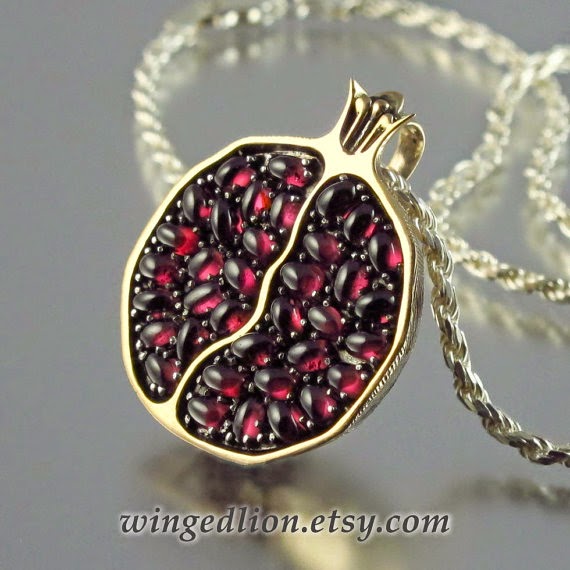
Modern Garnet pomegranate pendant by WingedLion on Etsy.com

The stone itself is composed of different amounts of minerals like Calcium, Iron, Magnesium and Aluminum, but the name Garnet is actually an overall term for 6 different mineral mixes; those mixes being grossular (clear-yellow-green colors), almandine (red-burgundy), pyrope (deep red), spessartite (yellow-orange-brown), andradite (brown-black), and uvarovite (emerald green colors).

Garnet has been known across history for its luminosity, and has been used in jewelry making for millennia. With such a long history, the stone is also richly steeped in metaphysical properties. Its red color symbolizes love and energy, and is believed to imbue the wearer with health and vibrancy. It is believed it can heal ailments of the blood and heart, and is also a traditional stone for friends and lovers. In the Medieval Ages in Europe, Garnet was also known to ward off nightmares and darkness, a testament to the stone’s glowing brilliance. 


http://tmora.org/museum-exhibitions/online-exhibits/golden-treasure-from-the-greeks-to-kyivan-rus/the-great-migration-garnets-of-ancient-jewelry/
Gold and Garnet bottle amulet from the 200s B.C.

While Garnets have been used since ancient times, they are traditionally considered a semi-precious stone because of their hardness (a 7 to 7.5 on the Mohs scale) and abundancy. Garnets can be found all over the world, and today most come from Africa. This abundancy makes them perfect to use in bead jewelry and metalsmithing. Designers that use this stone know that they have a real piece of jewelry-making history in their hands, and that their designs will shine with it!

Garnet beads available at DryGulch.com!

Tuesday, March 5, 2013

Just The Basics


Do you love jewelry?  Learn how to create your own.  This class, taught by Kristin Girard, on March 16th, 2-5pm, is an introduction to jewelry making.  You will learn the basics of bead stringing, crimping and finishing your designs using the correct tools.  Make earrings using wire and headpins, and much more!  Check out our website, here, for more details. 

Sunday, January 13, 2013

Interesting Pea Pods Created

The Pea Pod Pendant jewelry class was a huge success as seen in the above photo.  Beautiful and interesting pea pods were created as the ideas and designs flowed.  As always, it was great having Peggy Lierheimer, a very talented metalsmithing artist, teach the class.

And then, everything goes with a cupcake!!!